
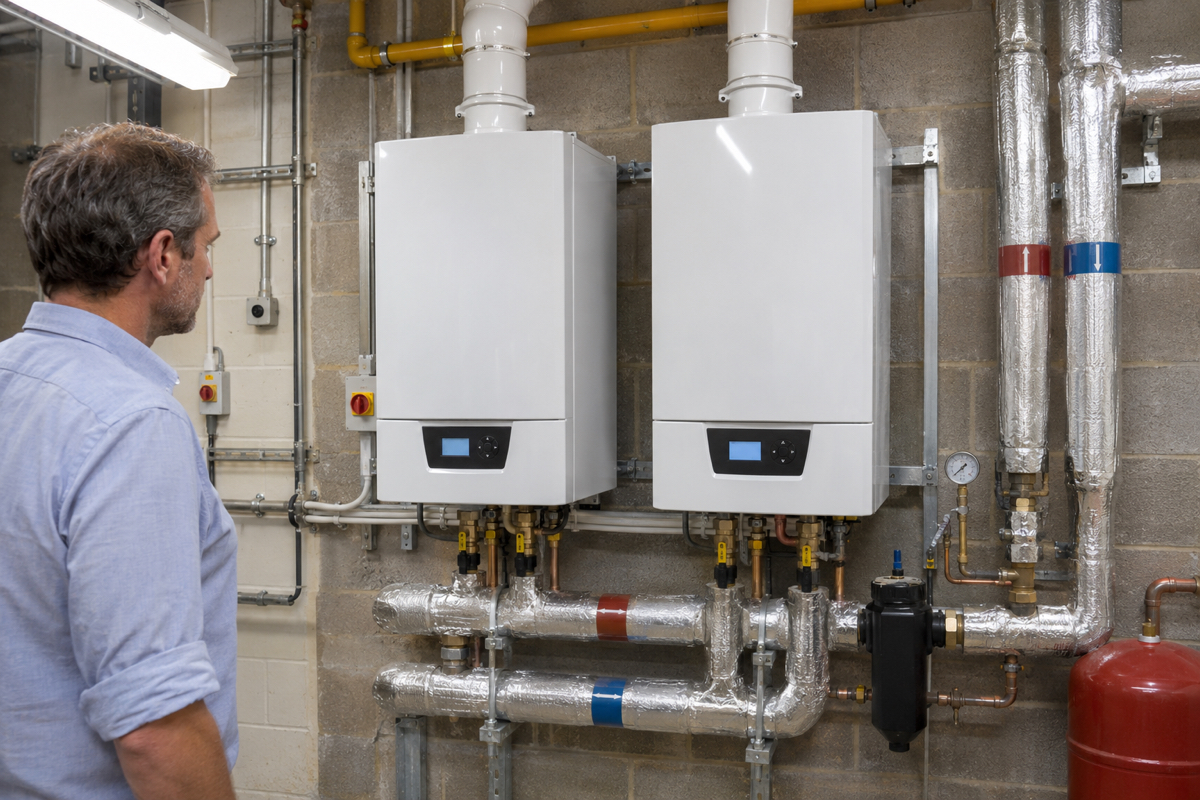
Use the Handover Records as Your Reference
Start with the commissioning record and the handover documents. These give your team a reference for the installed boiler models, control settings and the services the plant is intended to provide. Identify which circuits it serves and which contractor commissioned the controls. Use that information to interpret unusual patterns and ask specific questions of the contractor responsible for the relevant control or circuit.
A new boiler’s rated efficiency describes performance under defined conditions. A building’s demand changes with outdoor temperatures, opening hours, and how occupants use the space. The same boiler can run for a long period as a college warms up and then see a much lighter load once teaching rooms reach temperature. The operating pattern across that whole morning matters to the amount of gas the site consumes.
Some issues that appear after handover are best taken back to the commissioning team. A heating zone that regularly fails to reach its expected temperature or a schedule that keeps a boiler available long after closing deserves investigation. Ask the engineer to establish how the plant is meant to behave and resolve any departures from the agreed setup. The resulting operating record gives you a better starting point for assessing a retrofit.
The next scheduled visit with the commissioning team is an opportunity to put the records side by side. Bring the design schedule, the version currently running and an example of a day when the plant drew attention. If a new boiler starts repeatedly while a heating zone remains cold, establish why that zone is falling short before judging the starts. Where the building is already receiving the expected heat and the burner still switches on and off regularly, ask the engineer to review what the boiler is responding to between starts. Sorting out the two situations helps the estates team decide whether it needs a commissioning follow-up, a retrofit assessment or both.
Look at the Burner During Everyday Use
After morning warm-up, check when the controls call for the boiler to run, when the burner actually fires and how the flow temperature responds. Flow temperature is the temperature of the water leaving the boiler. If the available trend shows only an enable signal, ask the controls engineer which record can confirm when the burner was firing.
A modulating boiler can vary its output while it is firing. Demand can still be low enough for the boiler to reach its temperature target and shut off the burner. As the water cools, the burner may start again. The frequency of those starts and how much time the boiler spends firing are useful to review when demand is light. Optiburner identifies both modulating boilers and existing building management controls as configurations it can work with, subject to an installation assessment.
A Plant That Keeps Restarting
Imagine an office with new boilers that meet morning demand comfortably. Once the building is warm, the record shows a series of short burner starts during a mild afternoon. Look at whether the space-heating circuits are still taking heat and whether another load is active. If the pattern persists under normal operation after the controls have been checked, ask whether the water in the circuit still has useful heat at the point when the next burn begins.
A Plant That Settles Into Long Burns
A different site may find that its new boiler runs steadily during hours of demand and shuts down as expected when that demand ends. A firing-pattern review can help decide whether there is a worthwhile opportunity in the hours when it cycles. Include a mild day as well as a cold one, especially if the plant has only been observed during its first weeks in winter. Use those observations to decide what a fuller assessment would need to cover.
Hot water deserves a separate look where it makes up part of the load. For example, after a school day ends, a sports hall may still be open, and its changing rooms may need hot water. Check when the burner operates relative to that use and the space-heating schedule. A record of those hours helps the engineer judge whether apparently frequent starts coincide with a genuine change in demand.
What Optiburner Changes After Handover
Optiburner is a retrofit for commercial boilers. It uses heat still held in the system by adjusting the timing of the burner. When there is enough heat to meet demand, it can extend the interval before the next start. This can produce fewer burns, each a little longer, and reduce total time spent firing. The product monitors flow temperature and responds as the system calls for heat.
Bring the current control information to an assessment. The person reviewing the plant will need to understand when the building management system enables the boiler and how the boiler responds. Where several boilers work together, include the sequence in which the controls call them. It is particularly useful to know if the new plant has inherited parts of the previous control arrangement or if the controls and the boilers were renewed at the same time.
Bring the commissioning and controls contractors into the discussion if handover items are still open. They can explain which settings were agreed and how the boiler is being monitored. Before adding an optimiser, establish who will support the boiler, controls, and retrofit. The maintenance team should know whom to contact if a change in one part of the system affects another.
What Whitehall’s New Boilers Showed
At Whitehall, Optiburner Savings Reports were generated within a month of fitting the optimisers. East Sussex County Council also compared monthly gas readings before and after the optimiser installation, allowing for outdoor temperatures. The published analysis reported around 15.3% average gas savings across the year. Whitehall Independent School & Nursery
Whitehall shows that a recently installed boiler can present an opportunity for optimisation. The reported result applies to the school’s installation and the periods its council analysed. An assessment of another building needs to establish how much time the boilers spend firing steadily and how often they restart while there is still useful heat in the circuit.
Optiburner publishes typical fuel savings of 15–30% for its boiler optimiser. Use that range as context for a discussion of how your plant operates. Potential savings depend on the actual gas consumption for the boilers in scope and how they serve the building. Apply any estimate to that fuel use and check how sensitive the business case is to the assumptions.
Establish a Gas Baseline for the New Boilers
A boiler replacement may already be reducing fuel use. If you want to know how much difference a retrofit makes in the new arrangement, record how the replacement plant operates before the optimiser is fitted. Record the handover date, the controls in use and any changes to the building’s operating hours. Keep the previous boiler’s figures as a record of the wider project and identify the period that will be used to evaluate the retrofit.
If there is a dedicated boiler meter, record its reading dates and the gas consumption during the period you plan to compare. On a shared supply, identify the other equipment it serves and check what records are available to estimate the relevant boiler use. A contractor may be able to provide burner operation trends to help the assessment, particularly where a month of whole-site gas includes other loads.
A phased handover can distort a comparison. During a quiet month, one wing might still be empty, and the boilers may serve only part of the building. Establish when rooms returned to use and whether controls or schedules changed at the same time. Then select comparable periods for the review, allowing for the additional load once the building is operating normally.
For a new installation, even a short interval between commissioning and optimisation can yield useful information if the records are consistent. Retain the dates, meter scope and operating schedule. A short comparison may be enough to show a difference in burner behaviour. A budget estimate needs to reflect how often those conditions arise across the year, including times when the plant is serving higher loads.
After an installation, combine the Optiburner Savings Report with the records already collected. The report includes comparisons of burner operation with and without optimisation. Your gas readings and service delivery records provide further context. If the claim concerns the site as a whole, say which boilers and other uses the meter covers. If the interest is a specific unit, identify that unit in the firing records and check the evidence at that level.
Agree on which routine records can confirm that the new boilers provided the required service. For a college, that might include temperatures in representative classrooms at opening and how the hot water service performed during periods of high use. Those observations provide context for any apparent fuel savings on the same days.
Decide What Is Worth Assessing Now
If the plant has finished commissioning and its ordinary operating pattern is visible, review when the burner starts and why. A site with frequent low-load firing and a material demand for gas has a concrete question for an assessment. If heating schedules are still being corrected or other works will change the load shortly, arrange to collect representative data once those changes have settled. Both decisions follow from what the site records show.
For a project proposal, keep the estimate in kWh and value it at the gas unit rate the organisation pays for the relevant supply. Ask which boilers the installation quote covers and use the same scope in the fuel estimate. The business case should show the additional savings the retrofit could deliver from the new plant, using a reference period that finance and estates can explain.
Review Your New Boiler’s Operating Record
Ask Optiburner team to review your newly installed boilers. The commissioning record, details of the loads served, and a trend from an ordinary working day will help the team discuss whether there is an opportunity under your existing controls.
The Fuel Savings Calculator offers an early indication of potential savings. Use consumption for the replacement plant where available and note how much of its normal operating year your figures represent. Update the estimate once you have readings from a representative period.


